
Do you teach project management, PMBOK, Scrum or process management? Here is what I already use and publish, for you to take into your classroom: 16-week teaching plans (PMBOK 8, Scrum and BPM), a grading rubric, the PMBOK 8 Practice Test, 4 free courses with a certificate, 4 books and templates and real filled-in examples.
Ready to use today
How to get the teacher files: they are free for professors. Choose Professor when you create your free account. Already have an account? Message me on WhatsApp or at [email protected] and I unlock your access.
The 4 English books of the Together Series are on Amazon and work as the reading list for your plan; see the books.
One map: the 16 weeks of the semester
The three plans have 16 weeks and can be merged or split to fit your course hours. Open the one for your course:
PMBOK 8
The order follows the project life cycle, the same as the book PMBOK 8 in Action and the course. Each process leads to its article.
| Wk | Topic | PMBOK 8 Guide processes | Reading and course |
|---|---|---|---|
| 1 | PMBOK 8 foundations | Principles, domains and an overview of the Guide | Book ch. 1 · PMBOK 8 course: welcome and overview |
| 2 | Initiating the project and the stakeholders | Initiate Project or Phase Identify Stakeholders |
Book ch. 2 to 3 · PMBOK 8 course: the lessons on these processes |
| 3 | Scope: requirements, definition and WBS | Plan Scope Management Elicit and Analyze Requirements Define Scope Develop Scope Structure |
Book ch. 4 to 7 · PMBOK 8 course: the lessons on these processes |
| 4 | Schedule: resources and durations | Plan Schedule Management Estimate Resources Develop Schedule |
Book ch. 8 to 10 · PMBOK 8 course: the lessons on these processes |
| 5 | Finance: costs and budget | Plan Financial Management Estimate Costs Develop Budget |
Book ch. 11 to 13 · PMBOK 8 course: the lessons on these processes |
| 6 | Resources, engagement and communications | Plan Resource Management Plan Stakeholder Engagement Plan Communications Management |
Book ch. 14 to 16 · PMBOK 8 course: the lessons on these processes |
| 7 | Risk: identify, analyze and respond | Plan Risk Management Identify Risks Perform Risk Analysis Plan Risk Responses |
Book ch. 17 to 20 · PMBOK 8 course: the lessons on these processes |
| 8 | Procurement and the integrated plan — Delivery 1 | Plan Sourcing Strategy Integrate and Align Project Plans |
Book ch. 21 to 22 · PMBOK 8 course: the lessons on these processes |
| 9 | Executing: resources and team leadership | Acquire Resources Lead the Team |
Book ch. 23 to 24 · PMBOK 8 course: the lessons on these processes |
| 10 | Executing: engagement and communications | Manage Stakeholder Engagement Manage Communications |
Book ch. 25 to 26 · PMBOK 8 course: the lessons on these processes |
| 11 | Executing: quality, work and knowledge | Manage Quality Assurance Manage Project Execution Manage Project Knowledge |
Book ch. 27 to 29 · PMBOK 8 course: the lessons on these processes |
| 12 | Risk in action and project performance | Implement Risk Responses Monitor and Control Project Performance |
Book ch. 30 to 31 · PMBOK 8 course: the lessons on these processes |
| 13 | Controlling scope, schedule and finance | Monitor and Control Scope Validate Scope Monitor and Control Schedule Monitor and Control Finances |
Book ch. 32 to 35 · PMBOK 8 course: the lessons on these processes |
| 14 | Controlling resources, stakeholders and risk | Monitor and Control Resourcing Monitor Stakeholder Engagement Monitor Communications Monitor Risks |
Book ch. 36 to 39 · PMBOK 8 course: the lessons on these processes |
| 15 | Changes and closing | Assess and Implement Changes Close Project or Phase |
Book ch. 40 to 41 · PMBOK 8 course: the lessons on these processes |
| 16 | Review, practice test and final presentations | Review of the 7 domains and the 40 processes | Review of chapters 1 to 41 and the practice test |
Scrum
The order follows the book Scrum in Action and the Agile Together course: preparation, three Sprints and the final presentation.
| Wk | Topic | Reading and course | On the student’s board |
|---|---|---|---|
| 1 | Agile methods and the Manifesto | Book Scrum in Action, ch. 1 (1.1 and 1.2) · Agile Together course | No board step yet: each team chooses the course project |
| 2 | Scrum: the framework and the values | Book Scrum in Action, ch. 1 (1.2) · Agile Together course | No board step: each team draws the Scrum map |
| 3 | Objective and Key Results | Book Scrum in Action, ch. 1 (1.3 and 1.5) · Agile Together course | Menu step 1 asks for the project name and the objective (the O of OKR) |
| 4 | Tools and the board in ProjectAdm | Book Scrum in Action, ch. 1 (1.4 and 1.6) · Agile Together course | Step 1: create the board; the Inbox and the Reference list |
| 5 | Product Goal and Product Backlog | Book Scrum in Action, ch. 1 (1.7) · Agile Together course | Step 2: Product Goal and Product Backlog |
| 6 | Refinement and the Scrum Team | Book Scrum in Action, ch. 1 (1.8) and ch. 2 (2.2) · Agile Together course | Steps 3 and 4: refine and review the backlog |
| 7 | The Sprint and Sprint Planning | Book Scrum in Action, ch. 2 (2.1, 2.1b and 2.3) · Agile Together course | Step 6: Sprint Planning |
| 8 | Sprint Backlog: Sprint 1 starts | Book Scrum in Action, ch. 2 (2.4 and 2.5) · Agile Together course | Steps 5 and 6: break items into tasks and plan the Sprint |
| 9 | Daily Scrum and impediments | Book Scrum in Action, ch. 3 · Agile Together course | Steps 7 and 12: Daily Scrum and logging an impediment |
| 10 | Sprint Review | Book Scrum in Action, ch. 4 (4.2) · Agile Together course | Step 8: Sprint Review |
| 11 | Sprint Retrospective | Book Scrum in Action, ch. 5 (5.8) · Agile Together course | Step 9: Sprint Retrospective |
| 12 | Definition of Done and the Increment | Book Scrum in Action, ch. 4 (4.1) · Agile Together course | Review the project's Definition of Done |
| 13 | OKR Check-in and Sprint 2 | Book Scrum in Action, ch. 5 (5.1 to 5.7) · Agile Together course | Step 10: OKR Check-in (the 4 KRs read from the board) |
| 14 | Sprint 3: the full cycle, no new lesson | Review of chapters 2 to 5 of Scrum in Action and of the Scrum Guide | The team runs Sprint 3 on its own: Planning, Daily, Review and Retro |
| 15 | Final presentation and lessons learned | Book Scrum in Action, ch. 6 (6.1 to 6.5) · Agile Together course | Step 11: final presentation |
| 16 | Final presentations and after the 3 Sprints | Book Scrum in Action, ch. 6 (6.6 and 6.7) and ch. 7 · Agile Together course (graduation) | Final presentation and continuity |
BPM
The order follows the book BPM in Action and the BPM Together course: the 5 phases of the BPM life cycle on a real process.
| Wk | Topic | Reading and course | On the student’s board |
|---|---|---|---|
| 1 | What a process is, and the value chain | Book BPM in Action, ch. 1 (1.1 and 1.2) · BPM Together course | No board step yet |
| 2 | BPM and the 10 principles | Book BPM in Action, ch. 1 (1.3 to 1.5) · BPM Together course | No board step |
| 3 | The 5-phase BPM life cycle | Book BPM in Action, ch. 1 (1.6 to 1.8) · BPM Together course | No board step: the cycle becomes the 5 lists |
| 4 | Setup and choosing the process | Book BPM in Action, ch. 0 and ch. 1 (1.9 and 1.10) · BPM Together course | Step 01: set up the process board (5 lists) |
| 5 | Modeling: levels and notation | Book BPM in Action, ch. 2 (2.1 to 2.3) · BPM Together course | Step 02 (preparation): describe the process in numbered steps |
| 6 | BPMN in 5 elements and reference models | Book BPM in Action, ch. 2 (2.4 to 2.6) · BPM Together course | Step 02 (preparation): draw the AS-IS by hand with the 5 elements |
| 7 | AI and bpmn.io: your AS-IS | Book BPM in Action, ch. 2 (2.7 and 2.8) and Appendix A (A.1 to A.4) · BPM Together course | Step 02: model the AS-IS (cards + .bpmn file) |
| 8 | Analyzing the AS-IS: prioritize and discover | Book BPM in Action, ch. 3 (3.1 to 3.4) · BPM Together course | Preparing step 03: the key discovery questions |
| 9 | SWOT and benchmarking | Book BPM in Action, ch. 3 (3.5 and 3.6) · BPM Together course | Preparing step 03: SWOT and benchmarking |
| 10 | Root cause, costs and people | Book BPM in Action, ch. 3 (3.7 to 3.9) · BPM Together course | Step 03: analyze the process (handoffs, bottlenecks, no value, opportunities) |
| 11 | Designing the TO-BE: handoffs and principles | Book BPM in Action, ch. 4 (4.1 to 4.5) · BPM Together course | Preparing step 04: the prioritized opportunities |
| 12 | Simulation and the student's TO-BE | Book BPM in Action, ch. 4 (4.6 and 4.7) · BPM Together course | Step 04: design the TO-BE (cards + .bpmn file) |
| 13 | Performance indicators | Book BPM in Action, ch. 5 (5.1 to 5.5) · BPM Together course | Preparing step 05: name, formula, source and target of each indicator |
| 14 | The measurement guardian and the student's indicators | Book BPM in Action, ch. 5 (5.6 and 5.7) · BPM Together course | Step 05: indicators (cards and indicator file) |
| 15 | Transformation, technology and architecture | Book BPM in Action, ch. 6 · BPM Together course | Technology roadmap of the process |
| 16 | Final work and presentation | Book BPM in Action, ch. 7 · BPM Together course | Keys P (check progress) and F (final presentation) |
How your class uses it
- You choose what to use: the whole plan, only the practice test or just the templates.
- Your students join with a free account and take the practice test, the courses and the templates at their own pace.
- In class, the students compare their work with a real case, week by week: Project Phoenix in PMBOK 8, ProjectAdm in Scrum and Expense Reimbursement in BPM.
- Tell me what was missing. What professors ask for most often goes into my build queue.
Every week, in your inbox
One e-mail a week with material for your classes, and a question for you. If you chose Professor when you joined, you already get it; anyone can subscribe or stop here:
To subscribe, sign in or create your free account — it takes under a minute.
Sign in or create an accountNeed something different?
The PMBOK 8 Practice Test already exists. For other topics, other tests or tailored material, tell me your case: requests for customization will be assessed and built according to my availability and interest. The more professors ask for the same thing, the sooner it moves up the queue.
To get there faster
If you would like to talk about a partnership, or about mentoring or consulting for your class, just talk to me.
Why I offer this
I believe projects can build a more fraternal, more equal and freer world. Those who teach project management shape the people who will make that happen in practice. That is why the library is open and the class material is free.
Talk to Eduardo Montes on WhatsApp
Eduardo Montes, PMP, PSM I · Learn more
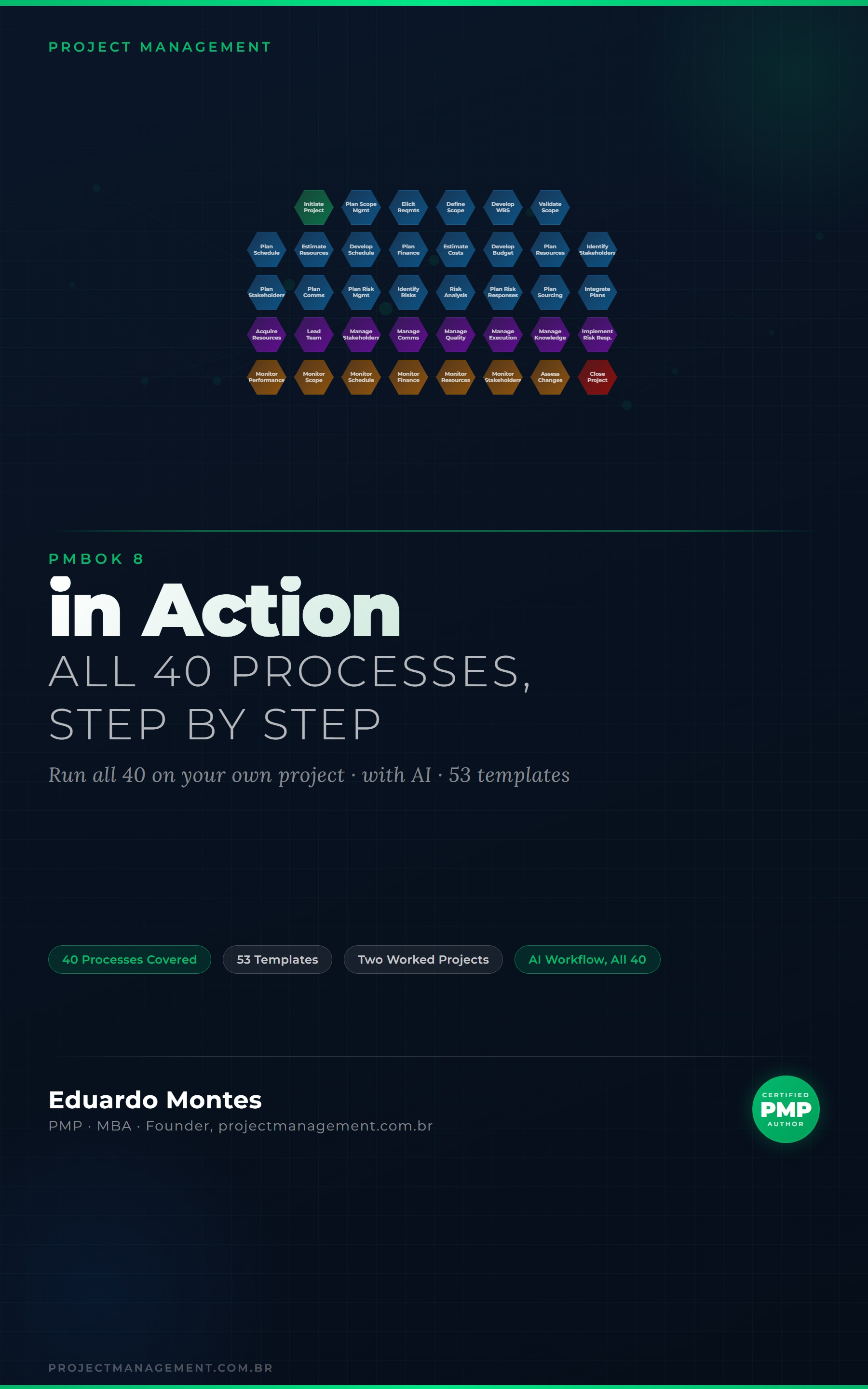
Go deeper in the book
PMBOK 8 in Action
The 40 processes of the PMBOK 8 Guide applied to one real project, with the finished artefact at every step.
See the book — US$ 9.98 → Project Together Office